

Innovation
At Akebia, we are inspired to think boldly and move bold thinking into action. We leverage our scientific expertise and this innovative thinking to develop clinical advances in areas that are important to people living with kidney disease.
We thrive as collaborators because we believe that we can go further together. We work with partners across the globe to pioneer and grow new areas of research and development.
We are optimistic and want to have a positive impact. Each day we bring our drive to life with the work we do.
Why Kidney Disease?
Chronic kidney disease, or CKD, is a condition in which the kidneys are often progressively damaged to the point that they cannot properly filter the blood circulating in the body. As kidney function declines, waste products build up in the blood, leading to other health problems, including anemia, cardiovascular disease and bone disease. CKD is a serious and life-altering illness that affects nearly 37 million Americans1 and an estimated 674 million people globally2.
We bring deep, cross-organizational expertise to the kidney disease community and are proud to support patients and providers through our purpose to better the lives of people impacted by kidney disease. Our two commercial products address anemia and hyperphosphatemia, which are frequent complications of CKD. Our kidney disease pipeline assets are being evaluated to target areas of unmet need.
Chronic kidney disease is persistent, progressive and irreversible.
Our Kidney Disease Pipeline
PRE-CLINICAL
PHASE 1
PHASE 2
PHASE 3
PRE-CLINICAL
PHASE 1
PHASE 2
PHASE 3
Praliciguat / sGC Stimulator 
Focal Segmental Glomerulosclerosis
- 54%
Ebribafusp Alfa (AKB-097) / Anti-C3d-Factor H Fusion Protein Complement Inhibitor
IgA Nephropathy
- 54%
Lupus Nephritis
- 54%
Complement 3 Glomerulopathy
- 54%
AKB-9090 / HIF-PH Inhibitor
Cardiac Surgery-Associated Acute Kidney Injury
- 30%
The programs described on this page are investigational and have not been approved by any regulatory authority, unless otherwise indicated. There is no guarantee that any investigational product candidate will successfully complete clinical development or receive regulatory approval.
Clinical Development
If you would like to learn more about our clinical trials, including becoming a participating investigator or referring physician, please email [email protected] or visit www.clinicaltrials.gov.
Akebia also seeks to partner and collaborate with healthcare professionals and researchers to investigate scientific hypotheses or questions related to our products and therapeutic areas of interest. Visit our External Sponsored Research page to learn more.
Beyond Kidney Disease
Leveraging our hypoxia-inducible factor (HIF) expertise, we are working to identify and initiate development planning for other programs where HIF-prolyl hydroxylase (PH) inhibitors may have therapeutic benefits.
Akebia contributed to Collaborative Research conducted by The University of Texas Health Science Center at Houston to evaluate a HIF-PH inhibitor for the treatment of acute respiratory distress syndrome (ARDS). The Vadadustat for the Prevention and Treatment of ARDS in Hospitalized Patients with Coronavirus Disease 2019 (VSTAT 110; www.clinicaltrials.gov; NCT04478071) completed in 2022 and the Vadadustat for the Treatment of Nonintubated Acute Respiratory Distress Syndrome Due to Pathogen-Associated Lung Injury (VSTAT 2; www.clinicaltrials.gov; NCT07086755 ) initiated in 2023.
AKB-10108 is a HIF molecule currently in preclinical development with targeted investigation for use in retinopathy of prematurity, or ROP, in neonates, and other indications.
We also aim to add to our pipeline and portfolio of novel therapeutics through internal discovery and development, and through strategic transactions, such as in-licenses, collaborations and acquisitions. In addition, given our expertise in research and development, we believe there may be opportunities to leverage these assets and establish mutually beneficial relationships with other companies that are looking to enter the kidney market or attempting to develop therapeutics to treat underlying causes or complications of kidney disease.
The programs described above are investigational and have not been approved by any regulatory authority.
SOURCES
- Centers for Disease Control and Prevention. Chronic Kidney Disease Data and Research. 2026.
- World Health Organization. Kidney disease. 2026.
- Nephcure Kidney International. Focal Segmental Glomerulosclerosis. 2026.
- DeCongelio M, Ali SN, Furegato M, et al. The incidence and prevalence of immunoglobulin A nephropathy in the United States. Clin Nephrol. 2025;103:19-25. doi:10.5414/CN111489. (PubMed)
- Brent LH, Batuman V. Lupus Nephritis Treatment & Management: Approach Considerations, Pharmacotherapy for Lupus Nephritis Based on Stage, Newer Therapies. Medscape. Updated October 24, 2025. (eMedicine); Centers for Disease Control and Prevention. People with Lupus. 2024.
- Smith RJH, Appel GB, Blom AM, et al. C3 glomerulopathy – understanding a rare complement-driven renal disease. Nat Rev Nephrol. 2019;15:129-143. doi:10.1038/s41581-018-0107-2. (PubMed)
- Pitcher D, Braddon F, Hendry B, et al. Long-Term Outcomes in IgA Nephropathy. Clin J Am Soc Nephrol. 2023;18:727-738. doi:10.2215/CJN.0000000000000135. (PubMed)
- Sinha S, de Courcy J, Libby S, et al. Treatment and Disease Burden in Patients with Complement 3 Glomerulopathy: Multinational Real-World Study Results. Glomerular Dis. 2025;5:380-394. doi:10.1159/000547744. (PubMed)
- Oosterom-Eijmael MJP, Hermanns H, Lankadeva YR, Hulst AH. Cardiac surgery-associated acute kidney injury. BJA Educ. 2026;26:92-100. doi:10.1016/j.bjae.2025.11.001. (PubMed)
- Bobrow B, Luber S, Potnuru P, et al. Identification of HIF1A as a therapeutic target during SARS-CoV-2–associated lung injury. JCI Insight. 2025;10(14):e191463. doi: 10.1172/jci.insight.191463
Praliciguat
BACKGROUND
Focal segmental glomerulosclerosis (FSGS) affects approximately 40,0003 patients across the United States and is a leading glomerular cause of end-stage kidney disease. It is characterized by scarring within the glomeruli, the kidney’s filtering units, leading to chronic and progressive kidney damage. Praliciguat is an investigational soluble guanylate cyclase (sGC) stimulator designed to target NO-sGC-cGMP signaling within the kidney, which is dysregulated in patients with FSGS.
A Study of Praliciguat in Participants with Focal Segmental Glomerulosclerosis (FSGS)
We are currently evaluating the safety and efficacy of praliciguat in adults with FSGS in a Phase 2, multi-center clinical trial.
Visit clinicaltrials.gov NCT07268638 to learn more.
Ebribafusp alfa (AKB-097; ADX-097)
BACKGROUND
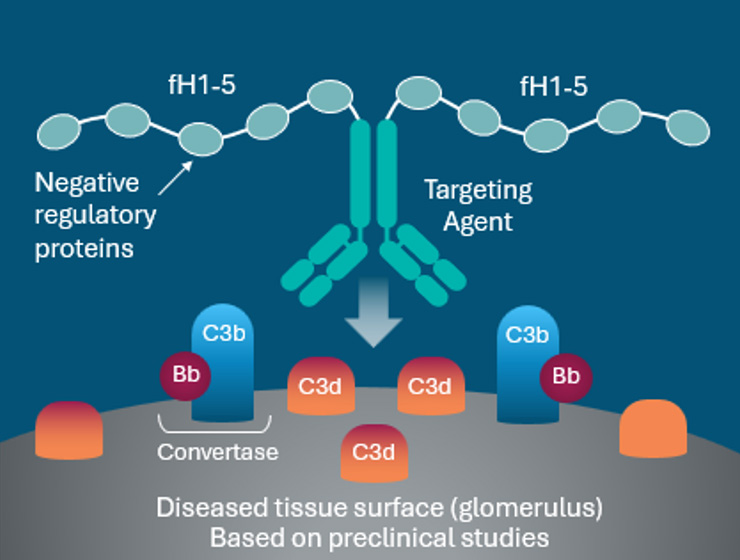
Ebribafusp alfa is an investigational complement inhibitor. The presence of C3d in human glomeruli is a hallmark of numerous kidney diseases. Ebribafusp alfa is designed to target complement activity in tissues to inactivate the alternative pathway C3 convertase.
Immune-mediated glomerular diseases include IgA nephropathy (IgAN), lupus nephritis (LN), and C3 glomerulopathy (C3G), which affect approximately 200,000,4 100,000,5 and 4,0006 patients in the United States, respectively. Patients with these conditions often experience kidney failure within 10 years of diagnosis.7 IgAN, LN, and C3G can result from dysregulation of the complement system, a central part of innate immunity.8
Ebribafusp alfa has an innovative proposed mechanism of action of combining an anti-C3d targeting domain with the complement regulatory protein Factor H (fH). The fusion of these proteins is designed to inhibit tissue complement in glomerular diseases while sparring systemic complement activity. Ebribafusp alfa is being studied with the goal of targeting local, uncontrolled complement activity and inflammation at the site of kidney injury.
A Study of Ebribafusp alfa in Patients with IgAN, LN or C3G
The Phase 2 basket trial is designed to evaluate the safety, pharmacokinetics, and clinical activity of ebribafusp alfa in patients with IgAN, LN, and C3G.
Visit clinicaltrials.gov NCT06419205 to learn more.
AKB-9090
BACKGROUND
AKB-9090 is an investigational, intravenous hypoxia-inducible factor-prolyl-hyroxylase (HIF-PH) inhibitor that is being developed for critical care indications, including cardiac surgery-associated acute kidney injury (CSA-AKI).
CSA-AKI, defined as sudden decrease in kidney function occurring after cardiac surgery, typically within 48 hours and can sustain for an extended period of time, is a common and significant complication9.
SAD and MAD Study of AKB-9090 in Healthy Adult Participants
The Phase 1, first-in-human trial is designed to evaluate safety, tolerability, pharmacokinetic, and pharmacodynamic effects of AKB-9090 in healthy adult participants.
Visit clinicaltrials.gov NCT07429006 to learn more.
Akebia Therapeutics, Inc.
180 Third Avenue, Floor 2
Waltham, MA 02451
+1 617.871.2098 phone
+1 617.871.2099 fax